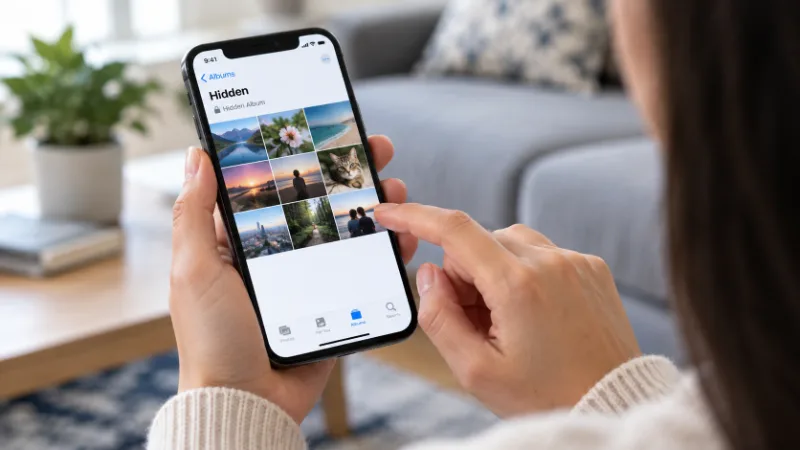

One is entitled to privacy, regardless of one’s technical acumen or the device in hand. Yet as our lives grow ever more connected, maintaining that privacy is no easy task.
Consider the modern iPhone: it is a repository for location data, banking apps, messages and a lifetime of personal photos. This is what has made the unassuming “Hide” option in Photos such a popular privacy tool on the platform.
Here’s the catch most people never learn: hidden photos iPhone are not the same as deleted, encrypted, or truly private photos.
Why This Matters Right Now?
One need not look far for evidence in 2026. There have been more than enough reminders already.
Al Jazeera and Reuters have reported on the leak of internal Tata Electronics manufacturing files with links to Apple’s supply chain, which put confidential documents and photos out in the open well ahead of any formal unveiling.
Then there was the matter of “DarkSword,” a fileless exploit for the iPhone that was found by security teams at iVerify, Lookout and Google’s Threat Intelligence Group.
Lurking on compromised sites, it could quietly siphon off iMessages, photo libraries and iCloud Keychain information from unpatched handsets, per TechRepublic.
A Short History of Hacking, Before Photos Were Even Digital
To understand why “hidden” doesn’t mean “safe,” it helps to look at how hacking itself evolved.
1. Phone Phreaking (1950s to 1970s)
Joe Engressia and John “Captain Crunch” Draper were among the hackers who, in an era well before the advent of smartphones, found a way to coax AT&T’s switching systems into letting them have free long-distance.
All it took was a 2600Hz tone, one that could be whistled from a trinket in a box of cereal. It was the first demonstration that so-called “trusted” systems were not beyond the reach of anyone with the knowledge to work their underpinnings.
2. The Morris Worm (1988)
The first major internet worm was the handiwork of Robert Morris, then a graduate student at Cornell. In doing so he inadvertently put thousands of university and government systems out of commission.
The fallout from the episode was considerable: it resulted in the first felony conviction to be made under the U.S. Computer Fraud and Abuse Act and was the impetus for establishing CERT, which would become one of the first formal teams for cybersecurity response.
3. PGP and Organized Hacking Groups (1990s)
When Philip Zimmermann made PGP encryption available to the public in 1991, it was not long before hacking evolved from a solitary pastime into something of an organized subculture, with outfits such as the U.S. Masters of Deception and Germany’s Chaos Computer Club leading the way.
4. Worms and Identity Theft Go Mainstream (2000s)
The threat landscape has only grown more serious since then. In the case of CodeRed or the “Love Bug” that followed, hundreds of thousands of machines could be compromised in a matter of hours.
And with the advent of social media and online commerce, attackers have found a new kind of target in personal and financial data that is far more profitable than before.
5. The Cloud Becomes the Target (2010s)
When the 2014 iCloud photo leak made headlines, it was a stark reminder to the world of how far hacking has come. No longer is it just about infrastructure; now personal photo libraries are fair game.
In that instance, the attackers had no trouble getting at private images in the cloud because of poor account security, they did not have to go after the device.
There is a pattern to it in every era. Why put in the work to break down the front door when there is an open side window? Be it a password that is too easy to guess, an app without the latest patch or a “hidden” folder with no real lock on it, the attacker will take the path of least resistance.
Modern Hacking Techniques and the Quantum Computing Twist
Attacks Are Faster Than Ever
There is no comparison between today’s threats and what was seen in the days of the Morris Worm; modern attacks are a good deal more automated and quick.
Case in point: according to the 2026 Unit 42 Global Incident Response Report from Palo Alto Networks, the swiftest intrusions of 2025 made it to data exfiltration in 72 minutes or less, a marked improvement over the 285 minutes it took in the prior year.
One would not call them novelties anymore. Phishing and watering hole tactics on reputable sites have become commonplace, as has fileless malware such as DarkSword.
The Real Threat Is Sitting in Storage
You won’t find the technique that has security teams’ undivided attention on a mobile device. It is taking place in storage, years in advance of any actual use. The method is known as Harvest Now, Decrypt Later (HNDL).
The premise is straightforward. An adversary will make off with your encrypted data or intercept it; they may be unable to make sense of it for now, but they put it away anyway.
Their wager is that with something like Shor’s algorithm, a quantum computer of sufficient power will come along and compromise the RSA or elliptic curve encryption that is currently safeguarding the information.
Is Hidden Really Hidden? How to Hide Photos on iPhone
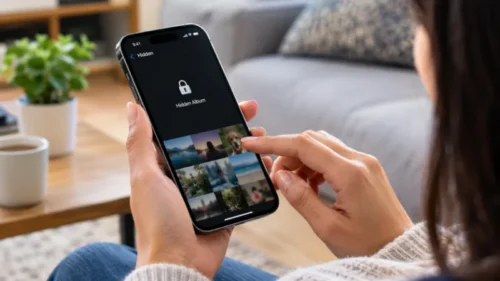
There is no denying the utility of Apple’s Hidden album; it is a feature well worth getting to know to appreciate its full scope.
How to Hide Photos on iPhone
- Open the Photos app and select the photo or video you want to hide.
- Tap the More (•••) menu, or touch and hold the image.
- Tap Hide, then confirm.
- The item moves to the Hidden album under Utilities and disappears from your main Library, other albums, and the Photos widget.
How to See Hidden Photos on iPhone
- Open Photos and go to Albums.
- Scroll to Utilities and tap Hidden.
- Authenticate with Face ID, Touch ID, or your passcode.
- Browse, unhide, or manage the photos as needed.
Why “Hidden” Isn’t the Same as “Protected”?
Most people overlook this: the Hidden album is a matter of visibility, not an encryption vault.
Its purpose is to keep a friend or relative from coming across anything private while they are idly looking through your camera roll.
Do not mistake it for something that can hold up against a determined adversary, or in the event of a stolen and unlocked phone and the like. It was not put in place to prevent long term data theft.
Where the Hidden Album Reaches Its Limits?
A few everyday scenarios show exactly where visibility-based hiding runs out of road:
- A lost or stolen phone: If the device is unlocked or the passcode gets guessed, the Hidden album opens just like any other album.
- Shared Apple IDs and family sharing: Household members with access to the same account or backup can often reach hidden content through iCloud settings.
- Forensic recovery tools: Data recovery software used by repair shops or investigators can frequently locate images regardless of their album placement.
- Legal requests and device searches: Hidden photos remain fully recoverable during a formal device search, since the album offers no cryptographic barrier.
None of this makes the Hidden album a poor tool. It simply means the feature solves a different problem than encryption solves.
Closing the Gap with Real Encryption
Dedicated encryption software is meant to fill the void, and this is precisely what it does. With an app such as QEncrypt Vault, for instance, one finds a different method at work.
The program will not simply put files out of sight; it enables you to place your photos, videos and documents in their own vault, secured by Face ID and quantum encryption.
That level of protection is intended to stand up to current assaults as well as the “harvest now, decrypt later” scenario we have been discussing.
Why the World Keeps Choosing Apple for Security?
We are not in any way criticising Apple with this. In fact, it goes some way to explaining the continued growth of iOS in territories where Android is king.
The figures for adoption make plain what happens when a buyer is on the hunt for privacy and biometric security or wants to be sure of long-term software support: they will invariably put Apple at the top of their list.
| Country / Region | Approx. iOS Market Share (2026) |
| Japan | ~68% |
| United States | ~59 to 60% |
| United Kingdom | ~57% |
| France | ~33% |
| Italy | ~27% |
| Germany | ~27% |
| Spain | ~25% |
| China | ~14% |
| India | ~8% |
| Global average | ~29 to 31% |
Figures are approximate, compiled from StatCounter GlobalStats, Axis Intelligence, and Demandsage market share reporting for 2026.
The Bottom Line
For day-to-day use, the hidden photos iPhone feature is a genuinely useful privacy tool. One should not mistake it for a vault, however; it was not built for that purpose.
There is a distinction to be made between something being out of sight and what is truly cryptographically secured.
In the long history of hacking, that has never been as important as it is today, particularly considering quantum computing which can make of tomorrow’s open book any data stolen from you now.
When it comes to material you would not have exposed under any circumstances; private pictures, financial papers or IDs, it is worth forming the habit of using Apple’s Hidden album in conjunction with a quantum safe solution such as QEncrypt Vault.
For anything of a sensitive nature, that added layer of encryption closes a gap that would otherwise exist.
Frequently Asked Questions
Can someone else see my hidden photos on iPhone?
Anyone who unlocks your device with your passcode, Face ID, or Touch ID can open the Hidden album directly. The feature hides content from casual browsing, not from someone with full device access.
Are hidden photos on iPhone encrypted?
The Hidden album changes where a photo appears, not how it is stored. Standard device encryption still applies, but the album itself adds no extra encryption layer on top.
Does the Hidden album back up to iCloud?
Yes. Hidden photos sync to iCloud like the rest of your library unless you turn off iCloud Photos entirely. The same account security rules that protect your regular library apply here too.
What is the safest way to store truly private photos?
A dedicated encrypted vault, such as QEncrypt Vault, gives sensitive files a security layer built for long-term protection, including resistance to Harvest Now, Decrypt Later attacks.
Will quantum computers break today’s encryption?
Most security researchers expect quantum computers capable of breaking RSA and elliptic curve encryption within the next decade. That timeline is exactly why HNDL attacks target encrypted data now, banking on future decryption power.