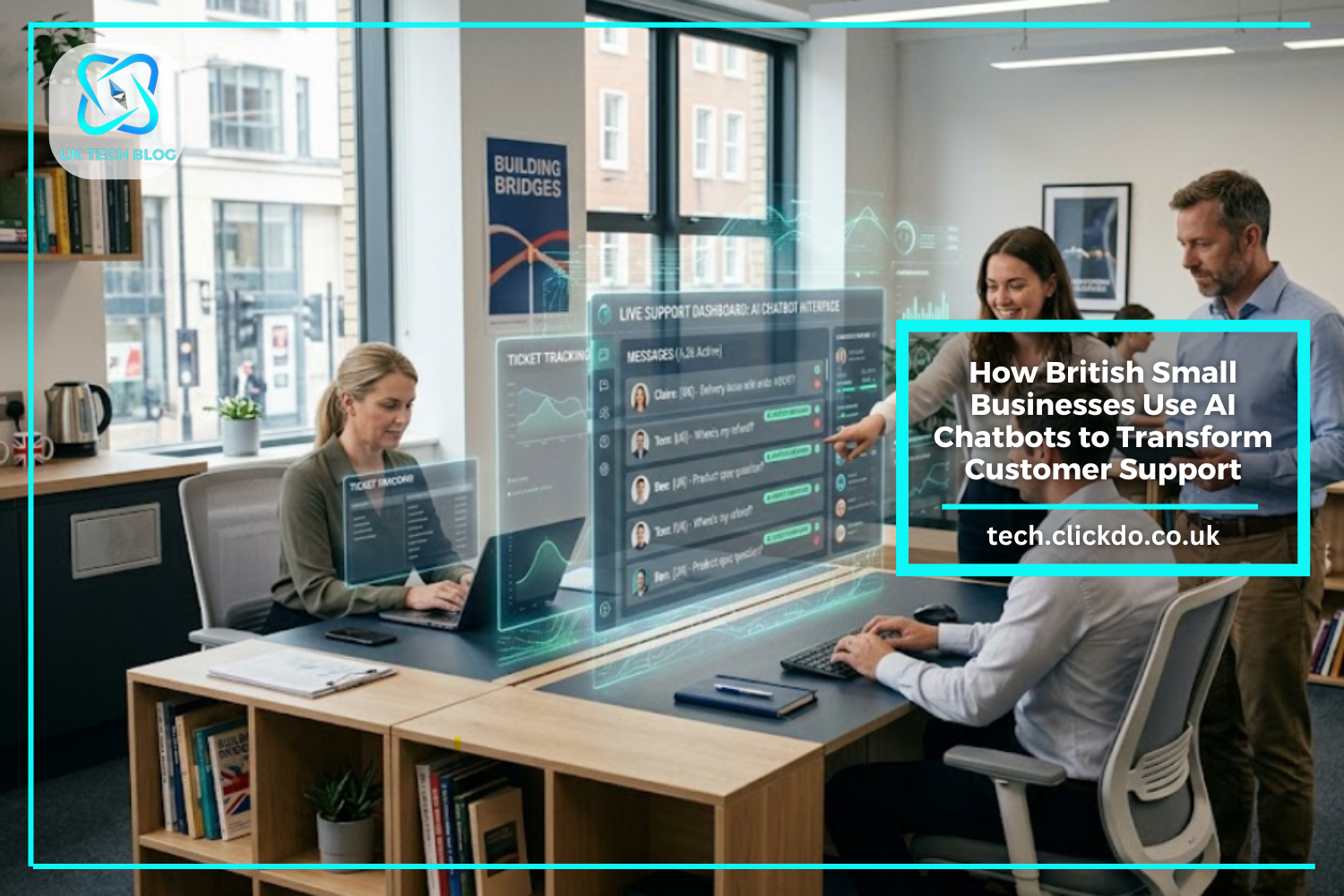

For a long time, AI-powered customer support felt like something reserved for large enterprises with deep IT budgets and dedicated development teams. That perception has shifted considerably. Across the UK, small and medium-sized businesses are deploying AI chatbots to handle customer queries, reduce support costs, and deliver the kind of always-on service that customers have come to expect.
The technology has matured quickly, and the barrier to entry has dropped to the point where a business with a handful of employees can set up and run an AI chatbot with minimal technical knowledge.
The shift is partly driven by how fast adoption has moved. A recent survey by Moneypenny, which polled 750 UK business decision-makers in 2025, found that 39% of businesses were already using AI in some form, with another 31% actively considering it. That puts the total share of companies either using or seriously evaluating AI at close to 70%.
Customer service is consistently one of the most cited areas of application, which makes sense: it is a function that involves high volumes of repetitive interactions, operates across time zones and out-of-hours windows, and has a direct and measurable impact on customer satisfaction.
Why the economics make sense for SMBs
The practical appeal for smaller businesses comes down to a straightforward calculation. A human support agent can handle one conversation at a time, works fixed hours, and needs training, management, and time off. An AI chatbot handles unlimited simultaneous conversations, operates around the clock, and improves over time as it processes more interactions. For a growing business that cannot yet justify a full-time support team, this is a meaningful operational advantage.
There is also the question of ticket deflection. Many support queries are repetitive: order status, opening hours, returns policies, account resets. When an AI chatbot handles these reliably, human agents can focus on the complex or high-value conversations that genuinely require their attention.

Businesses that have deployed well-configured AI tools via their website consistently report a reduction in routine query volume reaching the human support team, which translates directly into lower staffing costs or faster response times for customers who need real help. Meeting customer expectations is not purely a cost exercise.
According to the Zendesk Customer Experience Trends Report 2026, 64% of consumers say they are more likely to trust and engage with AI agents that display human-like traits such as friendliness, empathy, and personality. That figure signals something important: the quality of the interaction matters more than whether it is human or automated. A chatbot that responds with warmth and clarity, routes queries intelligently, and knows when to bring in a human is one that builds brand confidence rather than eroding it. Businesses that get this right can generate genuine customer loyalty through their AI tools, not just efficiency gains.
How different Types of UK Businesses apply the Technology
The use cases vary by sector, but a few patterns have emerged. E-commerce businesses, particularly those without the staff capacity to maintain live chat during peak periods, have been among the earliest adopters.

An AI chatbot can handle the surge in queries that comes with seasonal sales or product launches without any increase in overhead. Businesses that operate across multiple time zones or have international customers have found particular value in the 24/7 availability aspect.
Service businesses, including agencies, consultancies, and professional services firms, are using chatbots differently. Rather than pure transactional support, many are deploying them as intake tools: qualifying enquiries, collecting brief information from prospective clients, and routing conversations appropriately before a human picks them up.
This reduces the administrative burden on teams while ensuring that potential clients get an immediate response rather than waiting hours for someone to read through a message queue.
SaaS companies and software businesses have been among the more sophisticated adopters. For these teams, an AI chatbot that integrates with a knowledge base can resolve product questions, guide users through setup processes, and escalate complex technical issues to the right human specialist.
The result is a support operation that scales with the product without requiring the team to scale at the same rate.
Choosing the right Chatbot Tool
Not all AI chatbots are built the same way, and the options available to businesses today range considerably in capability, complexity, and cost. The most basic tools operate on fixed decision trees: if a user says X, show response Y. These work for very simple scenarios but become a source of frustration quickly when customer queries fall even slightly outside the expected pattern.
More capable platforms use natural language processing and large language models to interpret intent, maintain context across a conversation, and generate responses that feel genuinely useful rather than robotic.
The best of these can connect to existing business systems, trigger actions like updating an order or issuing a refund, and hand off seamlessly to a human agent when the situation warrants it.

For businesses at the start of this evaluation process, a detailed comparison of leading platforms is available in Zendesk’s guide to the best ai chatbot options, which covers both general-purpose tools and those built specifically for customer service.
When assessing platforms, integration capabilities deserve close attention. A chatbot that operates separately from an existing helpdesk or CRM will create data silos and complicate handoffs to human agents.
Ideally, the tool should feed into the broader support workflow rather than sitting in isolation. Security and compliance are equally important considerations, particularly around UK GDPR: any platform handling customer data needs to meet those requirements, and vendors should be transparent about how data is stored, processed, and used.
Businesses that report the strongest results from AI chatbot deployments tend to invest time upfront in mapping common customer journeys and ensuring the chatbot has access to accurate, current information.
They treat the initial deployment as a starting point rather than a finished product, reviewing conversation logs regularly to identify where the bot falls short and refining its responses accordingly. And they are clear with customers about what the bot can and cannot do, which builds trust rather than eroding it.
The expectation that AI-powered customer support is only for larger organisations is becoming increasingly difficult to sustain as the tools become more accessible and the evidence of impact at smaller business level accumulates.
For UK businesses still on the fence, the practical question is no longer really whether to adopt but how to start in a way that fits the specific context of the business, the volume and nature of customer interactions, and the team’s capacity to manage the transition well.